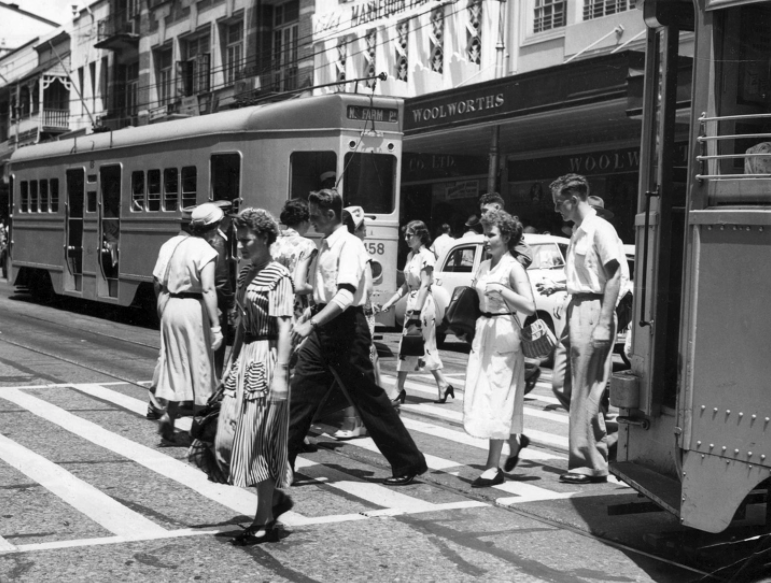
Since its development in the late 1940s, the distinctive black and white striped zebra crossing has remained largely unchanged. But, with pedestrian fatalities reportedly on the rise, should we be rethinking how to approach this ubiquitous design?
In the UK, a responsive LED pedestrian crossing that disappears when it’s not needed, adapts to changing pedestrian conditions and alerts drivers to emergency situations is being prototyped.
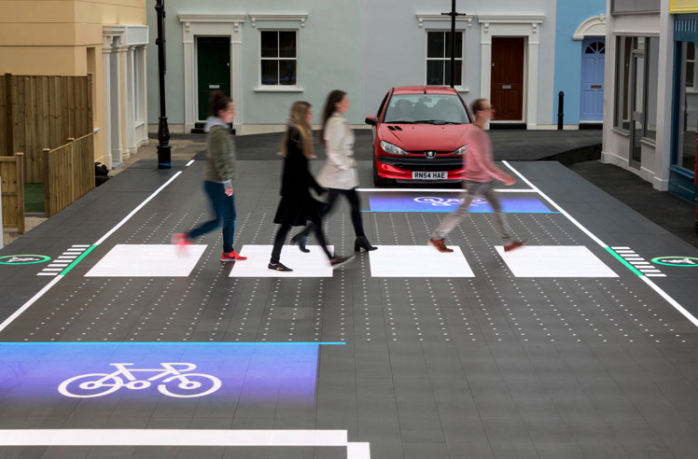
Dubbed the Starling Crossing, the technology is being trialled in a full-scale prototype on a private road in South London.
The designers, UK technology company Umbrellium, say while most discussions about road technology focuses on vehicles, their crossing design ‘puts people first’, by responding dynamically in real-time to make pedestrians, cyclists and motorists more aware of each other.
Roads are lined with a material embedded with LEDs, and tracking cameras act essentially as motion sensors. As people approach the road, the footage from the cameras triggers the LED lights, and a crossing lights up the ground.
This high-tech road design has the ability to ‘learn’ common pedestrian routes and volumes at certain times of the day and adjust itself accordingly – for example, it can widen temporarily to accommodate people leaving a cinema, or become diagonal to better reflect the path people take when leaving a train station.
If there’s no need for it, such as early in the morning, the crossing can disappear, and reappear if a pedestrian approaches.
For distracted smartphone users, the Starling could literally be a lifesaver. Speaking to News Corp earlier this year, Lachlan McIntosh from the Australasian College of Road Safety said both drivers and pedestrians were too often being distracted while using roads, particularly by mobile phones.
“Crossing the road using your mobile is as dangerous as driving while using your mobile,” McIntosh said.
In the Starling Crossing, if a pedestrian is distracted, looking down at their mobile, and veers too close to the road surface when a car is nearby, a warning pattern lights around them to fill their field of vision.
Additionally, if a child runs into the road unexpectedly, a large buffer zone is created around them to make their trajectory clear to any nearby drivers or cyclists.
The crossing can reportedly also assist with situations where blind spots are created for cyclists and pedestrians, such as when a large car or van is blocking the view. At this point, the cyclist will see an LED warning signal to alert them to a person being out of their line of vision.
The next phase of the project will see the company carry out more testing, designing and consultations, while approaching local councils to gauge their interest, Usman Haque, founding partner at Umbrellium, told Design Week magazine.
Although the prototype crossing involved the LED-embedded material being laid down on top of existing roads, a permanent crossing could require existing roads be replaced.
“This is a complex-enough initiative, beyond just the technology,”
he told Design Week.“We need to start interacting with councils and identifying appropriate partners now, to work out deployment logistics. That’s crucial throughout the development of the design.”
He adds: “I see this as one of many other strategies to make roads more pedestrian-friendly, such as those to do with shared public spaces and cycle lanes. We don’t want to design for vehicles, we want to design roads for how humans interact with each other and their environments.”
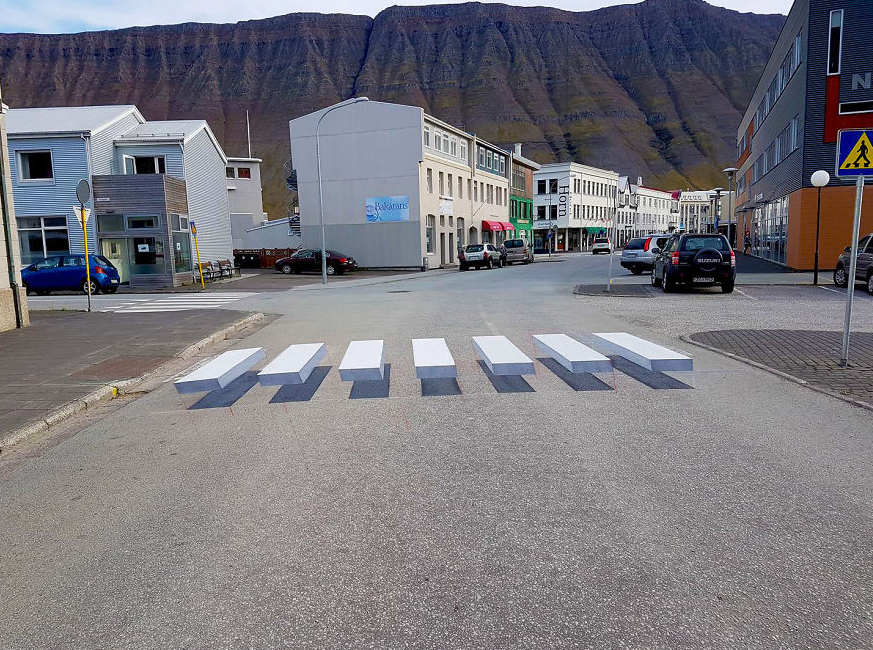
In Iceland, authorities are trialling a far more low-tech, but equally intriguing new pedestrian crossing design.
Using clever 3D painting techniques, a zebra crossing in the small fishing town of Ísafjörður now appears to hover above the road.
The aim of the mind-bending, floating zebra stripes illusion is to slow down motorists travelling through the town. Icelandic environmental commissioner Ralf Trylla called for its placement in Ísafjörður after seeing a similar project being carried out in New Delhi, India.
3D crossings are reportedly being used or tested in several countries, including South Africa, Germany, Japan, China and Kyrgyzstan.
Images: 1. The Starling Crossing pilot in South London2. The zebra crossing on Queen St, Brisbane, in 1952. 3. The 3D zebra crossing in Iceland. Read more: Bringing zebra crossings back to the urban jungleCould an illuminated zebra crossing reduce pedestrian fatalities?