By Christina Yip and Tim Mumford, Independent Project Analysis
The Australian Financial Review headline 'Blowing infrastructure cash: Australia wastes $108 million per $1 billion invested' clearly indicates opportunities for improvement in the delivery of infrastructure projects.
In the 2016-2017 budget announcement, the Australian Government committed more than $50 billion for current and future investments. But the Financial Review is right. Without an improvement in the current government’s project practices, we stand to lose at least $5 billion of taxpayer’s hard-earned money.
Let’s start by measuring
Differences undoubtedly exist between capital projects delivered by the private sector versus those executed by government organisations at all levels (federal, state or local). Unlike the private sector, projects undertaken by government organisations are primarily funded by taxpayers and executed to benefit citizens over and above pure financial results. As such, there is no single set of project success measures that are universally applicable to organisations, either public or private. More appropriate success measures will depend on the organisation’s short and long-term strategies, the specific project objectives and scope, as well as the specific industry and environment in which they compete.
The table below shows some of the typical project outcomes metrics measured by organisations, which are often used as
proxy for project success.
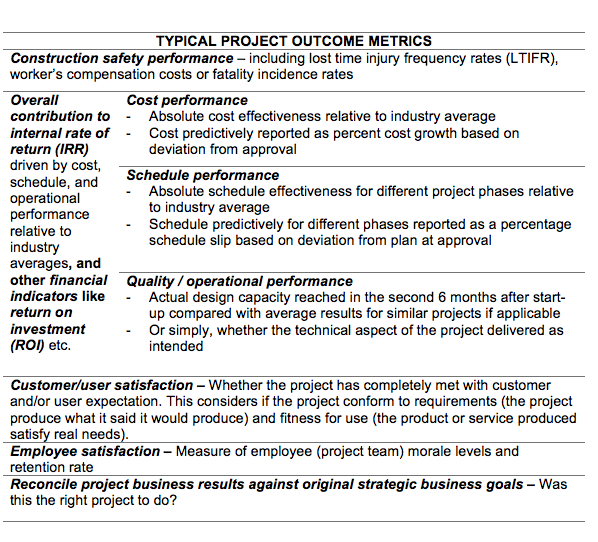
However, some project objectives are universal; all projects should strive to achieve irrespective of the drivers or project scopes. These include being predictable on cost and schedule, as well as working as expected without any safety incidents during project execution. Completing the project with lower cost and faster compared to other similar projects will be icing on the cake.
A tale of underperformance
Unfortunately, achieving success in any capital
projects in reality is a herculean task. Just over 50% of capital projects are delivered on time and 45% of projects ever deliver for the initial cost estimate, as shown below.
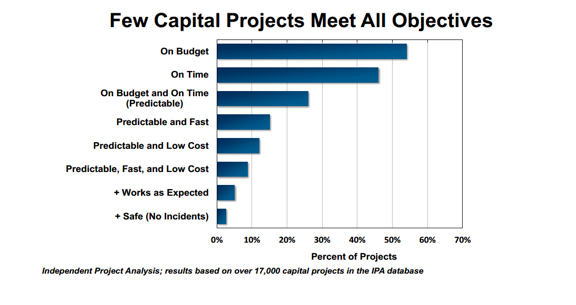
If you want both on-time and
on-budget, only one in four projects in
industry ever meet this goal. If you desire competitiveness, great safety outcomes, and full functionality, the number reduces to only 5% of all projects!
For every 20 projects we begin, only one of them on average will meet all the KPIs we initially set.
So how do we – as project practitioners and taxpayers – ensure that we deliver KPIs? Many project organisations begin this journey by focussing on data as a means to improve project performance. Data is used to support decisions, drive improvement and innovation. The basic requirement for improvement is the ability to set clear goals at the beginning of the project that can be measured upon completion.
The application of metrics
fulfil this requirement. Metrics provide a measure of performance that allows quantification of improvement opportunities, showing how well the project is performing relative to the plan. Metrics can also demonstrate your successful performance to competitors. Effective use of metrics requires:
- Knowledge on what specific information to collect
- The ability to communicate the key metrics that are crucial to the organisation’s continuous improvement
Both factors are equally applicable for projects delivered by the government organisations.
Competitive project systems often consider a broad range of project outcome performance metrics, not just one or two. These systems clearly identify the priority between performance on cost, schedule, operability, and safety; between predictability and competitiveness. While projects delivered by government organisations tend to focus on predictability, the importance of measuring ‘value for money’ on capital projects to drive continuous improvement in project systems for government organisations should not be overlooked (White, J. and Mumford, T. 2017).
Be careful what you measure
Project systems that focus on being predictable often lead to a punitive culture that results in more being paid than industry to complete a similar scopes of work. This is basic human nature. If you continually get in trouble for overrunning completed projects then the most reasonable behaviour is to set relaxed targets on future projects. Analysing the results of more than 17,000 capital projects in IPA’s database, it is obvious that we need to be careful what we measure. Shown below are the results of projects based on what we value most (and thus, measure):
- If you only measure cost predictability: you get projects that are expensive (for that same scope) but – unsurprisingly – have little cost growth
- If you only measure cost effectiveness: you get projects that are cheap (for that same scope) but commonly have operability issues and average delivery timelines
- If you only measure schedule predictability: you get projects that rarely slip initial promises but – unsurprisingly – set very relaxed targets as compared to peers
- If you only measure schedule effectiveness: you get projects that are fast; however, often experience poor operability and pay considerably more than their peers
In other words, a sole focus on single or specific project outcomes does not necessary lead to superior project performance. Instead, outcome measurements need to be considered in totality in order to firstly drive the right behaviours, and secondly reconcile the project performance against the original business objectives.
The fundamental difficulty in the continuous improvement of capital project systems is due to the fact that outcomes are lagging indicators; we can only measure success after the project has been completed. By the time these indicators are measured, it is too late for project teams to do anything to improve the project performance.
So how do you fix this? Instead of focussing on the measurement of project outcomes alone, the project team finds it more beneficial to have proven and reliable project leading indicators as a predictor of the chance of having successful project outcomes. Similarly, for the project system, the ability to accurately predict the outcome of projects within its portfolio can immensely support the improvement of the capital project system.
Best practice leading indicators pay dividends
So what are the key drivers of project performance that can be used use as reliable project leading indicators? What are the strategies that project leaders within all forms of project organisations can adopt to drive not only predictable project performance, but also to deliver safe projects at competitive costs and timescales?
Driven by the desire to improve financial returns through better project performance, many organisations in the private sector have adopted best practices in their capital project systems to produce greater cost effectiveness in their investment programmes. Best practices are project practices that are statistically associated – and have first-principles explanations – with excellent project performance. Some of these best practices include activities such as team development, front-end loading (i.e. quality of project definition achieved at approval), use of value improvement practices, and setting up strong project controls methodologies.
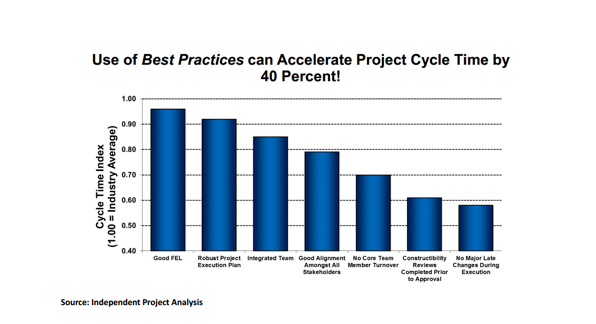
As seen above, the use of common best practice leading indicators, which are statistically correlated
to superior outcomes, should be adopted. Team development, as a leading indicator, is of the utmost importance. Team development rates the alignment amongst stakeholders, agreement on project objectives and priorities, and availability of team members at pertinent points of project definition.
Of similar importance is the quality of project definition at project sanction – this is a holistic assessment of how much residual uncertainty remains with site factors, permitting, project execution planning, and engineering. It is only then, when second-order leading indicators, such as value improvement initiatives or project controls, begin to add considerable value. More specifically: without clear objectives on what the project team should be doing and what the organisation values in the first place then items like
physical progression of materials at site tend to take a back seat when it comes to project outcomes.
A path forward
Infrastructure projects in Australia have the opportunity to learn from the private sector to improve their outcomes. However, successful measurement of best practices requires strong motivation to improve from all project organisations across all tiers of government. In some
ways they’re impeded by the fact that infrastructure programs are determined during voting cycles. More often than not, these voting cycles are shorter in length than the average large infrastructure project. This means that by the time a project is scoped, defined, engineered and mid-way through construction the new party comes
in to power. Unfortunately, government-led infrastructure projects are somewhat undermined by incoming parties’ agenda in combination with back-of-napkin estimating practices.
Further, the underlying motivation for the project stems from the political agenda. (PMI 2006) Hence, an opportunity surfaces as series of wish list items which are handed to a project team who are (magically) required to scope this into a feasible project (and deliver it).
Fortunately, there is hope. By establishing a strong capital project system that has good stewardship and employs best practices, it is possible for government organisations to start delivering infrastructure that is capital effective, thereby strengthening taxpayers’ confidence.
About the authors: Christina Yip and Tim Mumford, Consultants at Independent Project Analysis (IPA) Australia, have critically evaluated the drivers and outcomes of over 300 capital projects spanning a wide range of industries: infrastructure, manufacturing, oil & gas, refining and mining and minerals. These projects range in complexity (floating LNG to car parks) and have been executed over a wide-range of continents. Both Christina and Tim have also analysed the drivers of successful portfolio management and project governance.About IPA: Independent Project Analysis (IPA) is a global research organisation that partners with organisations to improve the definition and delivery of capital effective projects, project organisations and teams, and effective structures of project governance. Over the past 25 years, IPA has critically and statistically evaluated over 17,000 projects of various sizes and complexities across a wide range of industries from both private and public organisations.References:
- Australian Government – Department of Infrastructure and Regional Development, Infrastructure Investment, 6 January 2017. (http://investment.infrastructure.gov.au/)
- Jacob White and Tim Mumford, Benchmarking Towards Best Practice, IPWEA, 2017
- Michael Smith, Blowing infrastructure cash: Australia wastes $108m per $1b invested, Financial Review, 8 February 2017. (http://www.afr.com/brand/chanticleer/blowing-infrastructure-cash-australia-wastes-126m-per-13b-invested-20170207-gu7beb)
- Project Management Institute (PMI), Government extension to the PMBOK® Guide, Third Edition, 2006