All too often, feats of public works engineering go unnoticed by the people they serve. Instead of letting its historic driftwells fade into obscurity, Dubbo Regional Council decided to make them a tourist attraction, at the same time educating citizens about the important role engineers play in community development.
The multi-award winning Dubbo Regional Council’s Driftwells Park is a unique and multi-disciplinary project that involved the extensive re-design and upgrade of a public park – formerly an industrial site – and the provision of public access to two deep, large diameter driftwells of historic significance to Dubbo.
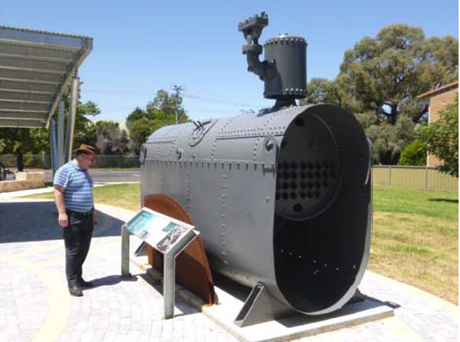
The original steam boiler and interpretative signage.
Source: Dubbo Regional Council
The project received an IPWEA NSW Engineering Excellence Award, was highly commended at the Engineers Australia Sydney Division Excellence Awards and was the recipient of the 2016 Parks & Leisure (Australia) Regional Award for the ‘Reinvigoration of an Industrial Site - Park and Open Space Development’.
Director of Technical Services Stewart McLeod says the Driftwells Park Project provides unsupervised and safe public access to two deep, large-diameter driftwells of historic significance to the city.
McLeod says detailed interpretive signs were installed to educate the community about the history of Dubbo’s water supply, the importance of a potable water supply to economic development, and celebrate the engineering profession.
“Not only has Driftwells Park become an important new tourist attraction, it also builds community resilience by promoting positive social interaction, helps reduce crime by increasing passive surveillance, and helps protect an important heritage site,” he says.
In 2014, an assessment revealed the driftwells were in excellent condition. This motivated the council to undertake a major project to re-design and upgrade the park, design and build public access to the driftwells and install interpretative signage.
Through the visual display, interpretative signage and the educational program developed for schools, the $510,000 project raises awareness of:
- the history and development of Dubbo’s water supply and the associated engineering challenges and triumphs
- the importance of an abundant, reliable, potable water supply to economic development and public health
- the unique and essential role the engineering profession plays
History of the driftwells
The driftwells are two deep, large diameter wells located in a public park. The first driftwell was sunk in 1893 and the second in 1909.
They were the source of water for Dubbo’s first reticulated water supply. The first driftwell was originally sunk to a depth of 24.38m. It is a brick infiltration well, with a diameter of 4.6m at the surface, flaring out to 6m below ground where the driftwell intersected the aquifer.
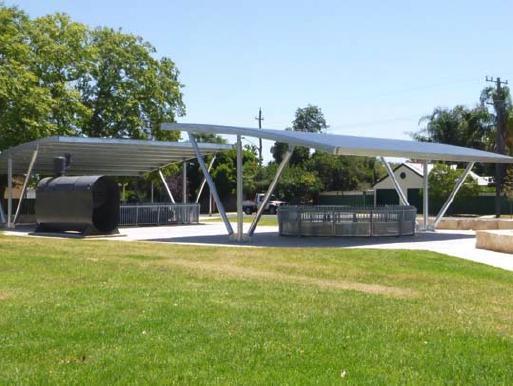
The Driftwells Park project, with the first Driftwell in the foreground.
When it was commissioned in 1894, two vertical duplex steam driven pumps pumped the water to an open concrete reservoir constructed on Newtown Heights, Fitzroy Street. The original reticulated water supply comprised roughly 18.5km of pipes. The new waterworks were officially opened by Sir George Dibbs, Premier of NSW in April 1894.
The second driftwell, with a diameter of 6m, was sunk just west of the first to a depth of 21.33m. It had two Goulds Single Action Triplex Piston Pumps, each driven by a Ruston, Proctor & Company compound steam engine. The original pumps, steam engines and boiler are still on the site.
The exact date that the driftwells were decommissioned is not known but it may have been as recent as the 1970s. On decommissioning, the driftwells were sealed.
Eventually, after one or two changes of use, the site of the driftwells was remodelled and became a small, unremarkable, urban public park. The original steam engines and pumps were made safe for public display but their significance left unexplained. Consequently, the existence of the driftwells faded from the public consciousness.