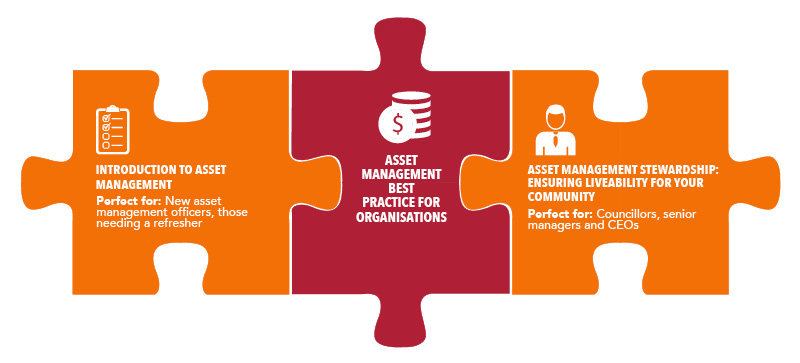
Two of IPWEA’s upcoming courses will provide organisations with vital pieces of the complete asset management puzzle.
The
Introduction to Asset Management course, recommended for staff members new to asset management, coordinators and staff that manage community infrastructure, offers a comprehensive overview of how sound asset management principles are essential to organisations. Drawing from the seminal asset management “bibles”, the International Infrastructure Management Manual (IIMM) and the Australian Infrastructure Management Manual (AIFMM), the course covers the recently introduced ISO 55000 suite of asset management standards, a good understanding of which is essential for anyone working in this space. Reference is also made to the recently released Australian Infrastructure Plan, which has implications for all who manage infrastructure at all levels of government.
Asset Management Stewardship: Ensuring liveability for your community is targeted at elected councillors, who are at the coalface of community engagement and responsible for obtaining value for their communities. This course will demonstrate to councillors how good asset management practices can assist in meeting their stewardship responsibilities. These issues are even more relevant in the light of the infrastructure challenges facing local government that have been highlighted in the Infrastructure Australia Audit and Plan.
Together, these targeted courses provide organisations with a holistic and practical overview of asset management principles.
intouch spoke to course author, asset management expert and IPWEA NAMS.AU Project Manager John Howard about how the courses will give participants the tools needed to excel in asset management and deliver benefits for their organisation.
Introduction to Asset Management
Participants in the one-day Introduction to Asset Management course will leave understanding basic asset management principles, the lifecycle asset management activities, how to identify and manage the consequences and likelihood of infrastructure risks, the tools available and how their peers are tackling asset management. The result will be new skills and experience, which they can use to enhance how their organisation conducts its business.
One of the most significant changes in the asset management landscape of late has been the introduction of the ISO 55000 suite of asset management standards. Howard explains the standards, introduced in 2014, have redefined the asset management landscape.
“Realising value previously involved balancing of costs, risks, opportunities and service performance,” Howard says. “ISO 55000 introduces the asset management system; the set of people, processes, tools and other resources involved in the delivery of asset management. This includes an asset management information system as one component of the asset management system.
“ISO 55000 also requires integration of plans including the organisation’s strategic plan, asset management policy, strategic asset management plans/asset management strategy, asset management plans through to operational plans and work programs.”
ISO 55000 helps change the mindset from one of focusing on the assets themselves, to instead focusing on what customers value and how to manage assets to best deliver those values.
“Asset management is the system of how we provide services to our customers/community,” Howard explains. “It involves meeting a required level of service in the most cost-effective manner through the management of assets for present and future customers.”
Asset Management Stewardship: Ensuring liveability for your community
Councils have hundreds of millions of dollars invested in infrastructure, so that they can provide services to their communities. The course is aimed at helping councillors – especially new councillors – understand that part of their role is managing community assets. CEOs and Senior Asset Managers similarly carry significant responsibility for these stewardship roles and would benefit from the course.
Howard explains that most councils are the largest and most complex business in town.
“Councils are called to make many decisions, often complex and with high consequences,” he says. Understanding asset management principles and plans can assist councillors in decision making, by knowing what questions to ask about infrastructure investment proposals to maximise community benefits and manage cost and risks.
“Having a clear understanding of these asset management principles is an essential qualification for all decision makers in our modern society.
“Asset management is about obtaining value from assets in providing essential community services while managing risk and cost. Understanding how asset management can help in managing service performance, cost and risk can deliver more sustainable services to the community. All involved in managing infrastructure have an obligation to deliver best value in services provided which this course highlights.”
Transform how your organisation manages its assets
Taking a strategic approach to managing assets requires a fundamental shift in the way organisations plan ahead, Howard says.
“Understanding life-cycle management activities – from planning through to disposal – will require participants to look at lowest life-cycle cost, rather than just short-term savings to help their organisations in making decisions,” he explains.
“Asset management extends over the life cycle of an asset – from identification of the need for an asset until decommissioning of the asset and managing any liabilities. Organisations need to shift from short term budget decisions to take a longer-term view, considering service performance, cost and risk.”
Improving an organisation’s service delivery performance will have real and measurable results.
“Service delivery performance requires managing cost and risk often in an environment of tightening finances,” Howard says ”Improving your knowledge of asset management principles will assist your organisation in providing services in a financially sustainable manner.”