When discussing the cost of asset corrosion, public artworks are often left out of the equation. However, with many artworks now featuring moving components susceptible to damage, it pays to be aware of the risks.
All structures – from domestic buildings and public artworks to commercial offices and harbour facilities – are affected by corrosion to varying degrees.
Each year, it is estimated that governments and organisations spend approximately 3% of GDP – the equivalent of billions of dollars – mitigating and repairing corrosion damage.
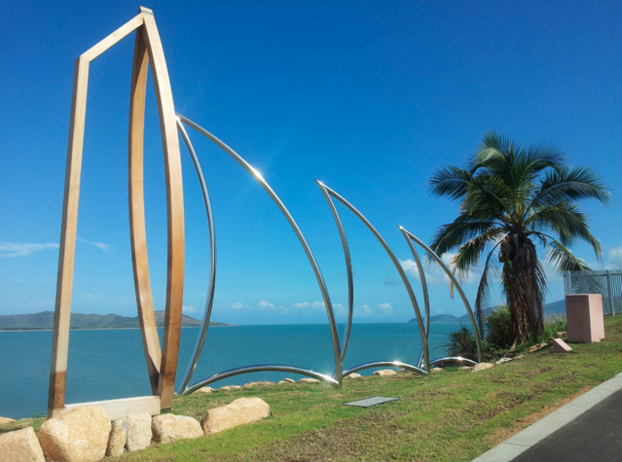
How to manage this degradation is a challenge for designers and engineers, as well as asset owners, managers and operators.
Public artworks are often monumental structures throughout a local government area that over time must be protected, repaired or rebuilt.
The degradation of the artworks themselves, and their support structures, is exacerbated by the fact that many cities in the Australasian region are situated on the coast.
According to Les Boulton, Principal Consultant of Les Boulton and Associates in Auckland, few people give public art a second thought as to how it should be looked after or protected. “Artists have a vision as to how their sculpture or painting will look but often don't factor in the effect of the environment in which it is displayed,” he added.
Boulton presented a paper at the most recent Australasian Corrosion Association (ACA) Corrosion and Prevention Conference, held in Adelaide November 2015.
Boulton has been involved in a variety of public art conservation projects in New Zealand. “Unfortunately, very few conservators have a metallurgical or scientific background,” he says. “They may be experts in art or history but can fail to follow appropriate engineering procedures, especially when dealing with large kinetic or wind sculptures.”
An often ignored issue is the prospect of litigation if the structure of a public artwork fails and causes damage or injury to the public. There are an increasing number of large public artworks that have moving components and it is these joints and bearings that are often the weakest point and which pose a threat to public safety if a failure occurs.
Boulton believes information about the effects and impact of corrosion on public art should be widely disseminated. “Very little has been written about this topic, as we could find no papers in the public domain dealing with the issue,” he says. Boulton added that his co-author on the paper he presented once told him the word “corrosion” wasn't even mentioned in art conservation training.
Another of the common type of damage inflicted on public art and infrastructure is graffiti. Some modern artworks include expanses of flat metal that attract vandals. Justin Rigby, coatings consultant at Remedy Asset Protection, says there are various types of coating that can be used depending on the type of art and the material it is made from.
Coatings are mostly classified as either sacrificial or non-sacrificial.
Sacrificial types are coatings which can be removed during cleaning to take away surface layers thus removing graffiti. Such a process can usually be repeated several times before a complete new coating needs to be applied. Examples are wax based coatings. Non-sacrificial coatings are extremely hardened materials that are much stronger than the harsh solvents that are used to dissolve and wash off the paint or ink used by vandals. The performance of the coating is only affected after many cycles of graffiti removal.
Rigby adds that some of the latest research involved 'nano-coatings.' “Most surfaces are porous at the microscopic level so graffiti can leach relatively deeply into a surface layer,” he says. “The material of a nano coating fills in all the tiny holes to create an essentially smooth, seamless surface that the ink or paint cannot penetrate.”
Rolling stock for trains, trams and busses usually have a strong, non-sacrificial polyurethane coating that can be cleaned relatively quickly.
The 2016 Corrosion and Prevention Conference is to be staged in Auckland's Sky City Convention Centre between 13-16 November.