A front-runner in the development of fully autonomous vehicles has secured a patent to allow cars to communicate with pedestrians, with a robotic arm among the options.
 While Google’s driverless cars have already logged more than a million hours on the road, there remain a litany of questions about how self-driving cars will interact with other road users and pedestrians.
One important issue is a driverless car’s inherent lack of ability to communicate its future movements to pedestrians.
A human in the driver seat will often communicate their intentions to pedestrians through hand signals, a flash of the headlights, verbally or otherwise.
Without a human driver, this of course becomes far more difficult. In the patent, Google stated:
“Other than signalling devices typical to non-autonomous vehicles, such as turn signals, headlights, high-beams, brake-lights, reverse-lights, and some audible signals (horns, reverse light beepers, etc), autonomous vehicles lack the capability to directly communicate the vehicle’s future behaviour.”
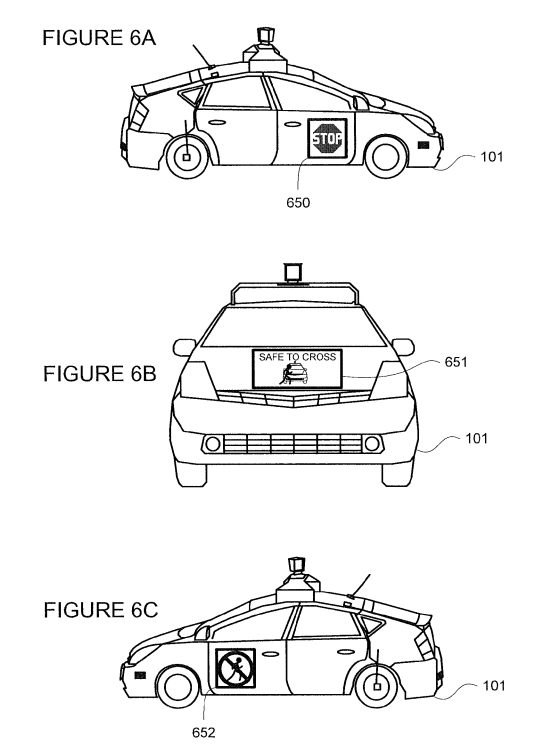
The patent, which was published on 24 November after initially being filed in September 2012, states that self-driving cars could accomplish this communication through, “a physical signalling device, an electronic sign or lights, a speaker for providing audible notifications, etc”.
Patent images (pictured right) show a “physical signalling device” resembling a robotic arm. Other images include signage on the front and sides of the vehicle, and a loudspeaker mounted on top.
In its November monthly self-driving car report, the company also discussed the technology used to navigate emergency vehicles.
“We’ve built up a library of various sirens (such as the long wail of a fire truck and the short shrills of an ambulance) and taught our software to identify them,” Google wrote.
“As soon as we’re alerted, our cars drive more conservatively (e.g., slowing down a bit or avoiding entering an intersection) until we have a better sense of where the sirens are coming from. Even if sirens aren’t sounding, our cameras are on the lookout for emergency vehicles and are designed to detect flashing lights. So if a fire truck is coming through an intersection, we’ll stop and let it through. Or if an emergency vehicle is approaching from behind, we’ll slow down and pull over until we know it’s safe to resume the journey.” 
The patent can be viewed on the United States Patent and Trademark Office website.