Stormwater has traditionally been viewed as a problem, with infrastructure engineered to get rid of it as quickly as possible.
But now, dwindling water stocks have increasingly seen many communities turn to stormwater as part of the solution to augment urban water supplies.
In New South Wales, an $11.3 million stormwater harvesting system was opened in July in Sydney Park, providing a sustainable water supply for the park and its wetlands while returning any remaining water to the Alexandra Canal.
The Chinese government has chosen 16 urban districts across the country to rollout a three year stormwater capture plan, with the aim of managing 60 per cent of rainwater falling on cities.
And, intouch recently featured the Bondi Stormwater Scheme, which uses recycled stormwater used for irrigation, public toilets and cleaning at Bondi.
California is entering the fourth year of one of the worst droughts in its history, with a state of emergency declared in January.
In October 2014, California passed legislation to encourage capture and use of stormwater. Los Angeles plans to rely on stormwater capture for up to 10 per cent of its total water supply in the next 20 to 30 years.
At Stanford University, Professor Richard Luthy is part of a team working with local and federal agencies in Los Angeles, Sonoma and other drought-stricken California cities in an unprecedented effort to capture and reuse stormwater.
The Silas H. Palmer Professor of Civil and Environmental Engineering and senior fellow at the Stanford Woods Institute for the Environment says stormwater reuse and recycling has the potential not only to supplement urban water supply, but also to reduce coastal contamination and beautify urban landscapes.
Wasted opportunities
Luthy says stormwater, for so long an ignored resource, will go a long way to helping meet future water needs.
“One of the things that’s gotten more discussion is how we can take advantage of the stormwater, capture and treat it, and use it for our urban water,” Luthy says.
“The situation with stormwater in our part of the country is that it has historically been managed for flood control.”
This can be clearly seen in Los Angeles, where the concrete-lined Los Angeles River has been the iconic scene of countless Hollywood car chases.
“You’ll see many of the rivers are literally concrete channels – because the idea was to get the water collected up and pushed out to a bay or an ocean as quickly as possible,” Luthy says.
One of the things that make stormwater an ideal way to alleviate pressures on urban water supplies comes down to the hip pocket - the water itself is free.
“That water is there for the taking basically,” Luthy says.
“Here we don’t have the water rights issues for the big cities in California”.
Luthy says reusing stormwater captured in San Francisco and Los Angeles could fulfill the annual indoor water demand of about 10 million people.
Getting a piece of the pie
Luthy says while stormwater will not be the only solution to solving future water needs, it needs to be part of the plan.
“We need to be thinking about how to make our urban water supply look more like a pie chart,” Luthy says.
At the moment, the “pie chart” is dominated by water imported through aqueducts - Luthy says a more diversified approach to urban water supply is needed.
“Stormwater capture can be a part of this - it’s not the whole answer but if you think in terms of (also utilising) conservation, recycling and smart use of desalination, then all of those pieces can work together,” Luthy says.
The nitty gritty of replenishing groundwater with stormwater
Before stormwater can be used to replenish groundwater supplies, the various contaminants picked up in the urban landscape must be removed.
Luthy and his team are in the process of developing systems to do just that.
“It’s a three fold system - capture, treat, recharge,” Luthy says.
“The idea of the treatment would be to remove the sorts of contaminants you find in urban runoff, the chemicals from roads and autos and those that you might use in urban areas like herbicides.
“These are not the same sorts of things you’d find in sewerage, but they are things you would like to remove.
In one system water would pass through a vegetated capture pond, which doubles as an animal habitat and utilises sunlight to deactivate waterborne pathogens and degrade some organic contaminants.
A combination of filters would then remove additional contaminants.
“We’re thinking about certain types of filters, sand with little bits of iron, filters that would involve wood bark, engineered biochar and oxide of manganese,” Luthy says.
A walk in the park 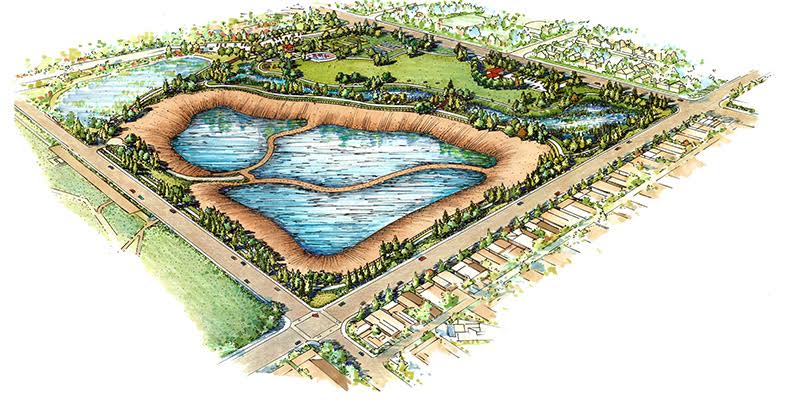
The research will be put into practise in the Rory M Shaw Wetland Park project, with which Luthy’s team is assisting.
The project will see 46 acres, formerly used as a construction debris landfill and gravel mining operation, transformed into a stormwater capture site, which will also increase flood protection in the area.
The Los Angeles County Flood Control District put $18 million toward the purchase of the site, and the City of Los Angeles paid the remainder of the $28 million cost. For construction of the stormwater facility, the flood control district will contribute about $44 million, and the city will put in $7.8 million.
From the wetlands, treated stormwater will be pumped to an existing groundwater infiltration system, which will contribute to aquifer recharge thereby providing a future drinking water source.
In addition to capturing, detaining and treating stormwater, the project will also transform formerly desolate landscape into wetland habitat, open space and recreational areas.
Construction is planned to begin in 2017, with a tentative end-date of 2020.
A real people pleaser
Luthy believes projects like the Rory M Shaw Wetlands Park tick a lot of boxes for a lot of stakeholders, making them more likely to receive support and funding.
“You want something that works for a number of groups,” Luthy says.
Minimising coastal pollution through capturing stormwater is a big tick for the environment and environmental groups.
“When it rains and you’re pushing all that water to the ocean as fast as possible, and you can cause beach contamination,” Luthy says.
“When we talk about stormwater capture, you get this push from people that are thinking about clean beaches and you get this pull from people that are thinking about a potential water supply.”
Creating green spaces for communities meant locals could also see the benefits.
“These stormwater capture systems are to be large, but they can provide green space and urban amenities,” Luthy says.
“You want these systems to look like a park and green the neighbourhood.
“You get community buy in, you get the buy in from the water department, and the environmental groups.”