Electrical engineer John Simpson restored his passion for his profession through his work with the humanitarian agency for international emergency relief RedR. He tells us what it takes to work in disaster struck regions.
Q. How did you get involved with RedR?
 A.
A. I saw an article in the Institute of Engineers Australia magazine, cut it out, eventually applied and was accepted on the RedR register. I went on the RedR training courses Essentials of Humanitarian Practice (EHP) and Personal Security and Communications (PSC) and also a basic telecommunications course with World Food Program (WFP), organised through RedR. Then I waited for a development I thought I could do and got it.
Q. Why did you get involved with RedR in the first place?
A. RedR deploys engineers (although not all deployees are engineers) and if you are deployed into a role where your previous professional experience and knowledge is required you might be more useful. I would like to believe the role was needed and I might do some good.
In a broader sense, working in the humanitarian sector was a change and was something different to the areas I had worked in before. It seemed a very interesting environment [in which] to work. At the time when appropriate deployment came up I was available, so I thought I would give it a go and see what happens.
Q. What was your first deployment for RedR?
 A.
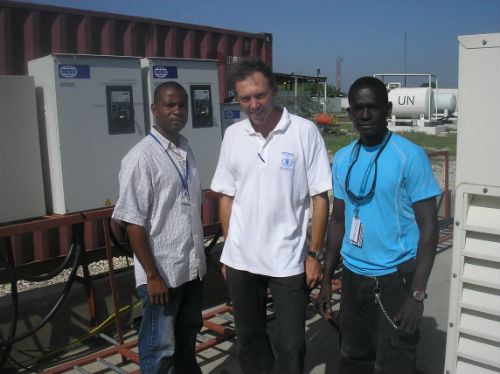
A. My first deployment was to Haiti (just after the earthquake) with the World Food Program (WFP) in their Emergency Telecommunications (ETC) section. My role was to organise the electricity supplies, mainly diesel generators to WFP facilities, offices and warehouses across Haiti. Much of the country had been destroyed and many simple things became much more difficult.
Getting around to facilities in the capital and around the country took a lot of time. There were shortages of many things and there were some unusual work arounds to get things working. Home was a tent (it was a nice tent) in the compound with other UN workers.
Q. How many deployments have you been on since then?
A. I have been on three other deployments. My second deployment role was also with WFP in Burkina Faso. The role was with the telecommunication section [and it] mainly involved electrical supplies and the radio networks.
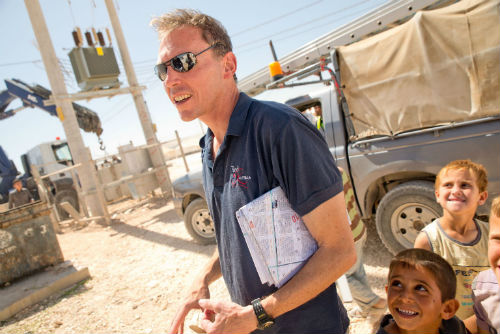
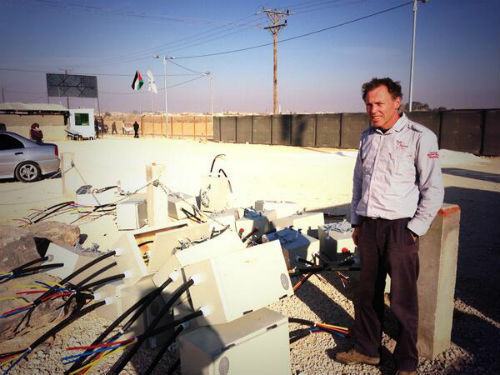
My third and fourth deployments (in the same role) were to Jordan with United Nations High Commission for Refugees (UNHCR). My role was to organise the electrical system in Zaatari Refugee camp, which is the second largest refugee camp in the world with up to 100,000 refugees living there.
The Zaatari role was the most challenging because it was a much bigger role. The role involved organising electrical supplies across the camp for hospitals, medical clinics, offices, schools, food distributions centres and supermarkets. Getting a limited electrical supply to the refugees and controlling their usage was also an enormous challenge.
Q. What has been your most memorable deployment and why?
A. The deployment in Jordan was the most memorable. The role had a large interaction with other people with expertise in areas outside my own, including health, site planning, security, WASH, field and community people. There was also a large interaction with the refugee community. I got to watch - and was part of - providing the infrastructure that help turn a refugee camp into something resembling a city.
Q. What is it about being involved with RedR that you enjoy most?
 A.
A. RedR is great organisation to be involved with. The training courses were excellent and the support you get when deployed is also excellent. I sometimes scratch my head when within a week from sending off an email accepting a deployment, I’m on the other side of the world with health checks and vaccinations completed; contracts signed; pay, travel and initial accommodation organised; health insurance and medical evacuation procedure in place, and the only thing you really have worry about is doing your job.
I enjoy being part of a team in one of the UN agencies, sometimes alongside RedR colleagues, but not always. The humanitarian need or emergency response is typically pretty obvious - there’s a lot going on and a lot to do. There is a clear sense of purpose and the people you work alongside are pretty motivated and dedicated. I’m [always] pleasantly surprised how quickly you are regarded as part of the team and how people from all corners of the world accept, trust and rely on each other and work together for a common purpose.
Q. Why would you encourage others to get involved?
A. I would encourage other people to get involved. Many of IPWEA’s members will have skills that will be useful and are needed in the Humanitarian sector. The majority of people I meet in the humanitarian sector find the work personally very rewarding.
If more people have a better insight into the humanitarian sector and the plight of some of the most vulnerable people in the world, this would be beneficial. The more people who are involved or aware of the need in the humanitarian sector, the easier it is for governments and other organisations to fund humanitarian assistance program, or implement other policies that assist refugee and internally displaced people (IDP) populations.
Q. What advice would you give to others who are interested in getting involved?
A. Do it. Your experience and knowledge is valuable but it probably will never be used in a way you thought. There will lots of unique situations needing unusual solutions so be prepared to be adaptable. Not everything will be done as it as home and, more often than not, there is a reasonable reason for it so make an effort to understand these reasons. I don’t think this gets easier with more deployments. Each deployment seems to be very different from the last with a whole new set of challenges not envisioned or previously seen. Even if it’s your first deployment, I don’t think you are at any significant disadvantage or less capable of dealing with challenges you are about to face than any other deployee.
Colleagues (RedR) on the ground where you are deployed or about to be deployed are one of the best sources of information. The RedR training courses, although more general, are also a good reference point on how to keep yourself safe, what isn’t acceptable behaviour, and how the UN system works. There will also be lots of advice from many other sources. [However,] many might not be applicable to where you are about to be deployed.
Q. How has being involved with RedR helped you in your professional career?
A. RedR has helped [me] get access to employment in the humanitarian field within UN Agencies. Some deployees have moved onto more permanent jobs with UN agencies and NGOs. RedR has certainly helped [me in] getting a career in the humanitarian sector and that’s my career at the moment.
It can be a fairly disjointed career with a series of for 3-6 months deployments around the world. I am not sure it helps career progression in more traditional sense of moving up the ladder. It takes a fairly understanding employer who lets people disappear for six months with a week’s notice. In another sense, it has increased (or maybe just restored) my enthusiasm for working as electrical engineer and kept me interested in my profession.
Photos (in order of appearance)
Photo 1. John Simpson in Zaatari - taken by Jared J Kohler for Yahoo UK news online
Photo 2. John Simpson in Zaatari - taken by Aoife Mcdonnell
Photo 3. John Simpson in Haiti - taken by John Simpson