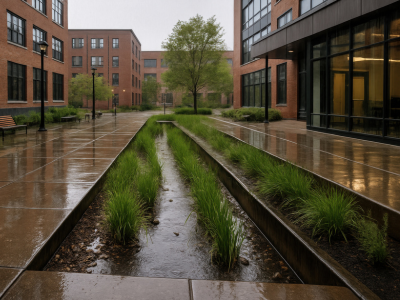
Apartment complex with bioswale for rainwater collection.
Across Canada, communities are navigating extreme weather, aging infrastructure and growing expectations around sustainability. These pressures are not theoretical. They are visible in how public spaces function, and in some cases fail to function, under current conditions.
In a recent conversation with SaskOutdoors—Saskatchewan’s provincial outdoor education association—board member Carmen Gilmore described what climate stress looks like at ground level. During heat waves, playgrounds sit empty when basic infrastructure such as shade or water access is missing. Heavy rain overwhelms systems designed for different weather patterns. Public spaces become difficult to maintain when long-term renewal and climate pressures are not integrated into planning.
Schoolyards offer a clear example. Gilmore described how grant programs often prioritize traditional structures while overlooking trees, shelter belts and other forms of green infrastructure.
“Often there’s no shade and no water fountain at a school park and people go home because it’s too hot. We’re not building for the reality kids are living in.”
Even when trees are planted, long-term care frequently depends on informal labour. Parents and teachers are relied upon to water, prune and maintain new growth without dedicated funding or lifecycle planning. Over time, Carmen says, this leads to “a breakdown” in sustainability.
This example reflects a broader pattern. The issue is not isolated to playgrounds. It is embedded in how infrastructure decisions are structured. Short-term projects often outpace long-term planning frameworks. Funding models reward installation but not maintenance. Green space is treated as an enhancement rather than service-delivering infrastructure.
When green infrastructure is undervalued or excluded from asset management plans, communities absorb future risk. Stormwater systems strain. Heat intensifies. Maintenance gaps widen. The “cost of doing nothing” is rarely immediate, but it accumulates across capital cycles and climate events.
Asset management provides one way to shift this pattern. As defined by the International Infrastructure Management Manual (IIMM), asset management is not limited to a specific job title. It is a shared responsibility among those making infrastructure investment decisions and those delivering services on the ground.
For Gilmore, asset management training reshaped how she approaches schoolyard greening initiatives, including tree planting, urban food forests and student-led shade audits. The shift was not only practical but strategic.
“We don’t just have to rely on moral persuasion anymore,” she explained. “We can make a case about long-term investment and what happens if you don’t think the whole problem through.”
This framing recognizes trees, wetlands and green spaces as assets that provide measurable services: cooling, stormwater management, biodiversity support and improved wellbeing. In cities such as Saskatoon and Regina, strategies are emerging to formally manage urban forests and natural assets as part of broader infrastructure systems.
However, not all communities have equal access to the tools required to make this shift. Small municipalities and First Nations communities often face staff limitations, short-term capital planning cycles and constrained funding structures meaning the gap between ambition and implementation grows.
One-off installations are not uncommon: trees are planted, bioswales are constructed, but long-term operations, maintenance and renewal are not fully integrated into financial and asset management plans. Guidance from the Municipal Natural Assets Initiative emphasizes that green infrastructure must be deliberately included in lifecycle planning if it is expected to deliver reliable service over time.
“It’s like buying a car and not budgeting for gas or insurance,” Gilmore says, “We’re doing that with infrastructure...we build things with no maintenance plan, no resources, no staff.”
Without long-term planning, communities are exposed to increased risk, a pattern that illustrates the real cost of doing nothing.
Experiences like Gilmore’s point to a broader need for shared frameworks and practical tools. When practitioners, advocates and municipal staff speak a common asset management language, green infrastructure can be planned alongside built assets rather than treated separately.
Green infrastructure underpins many essential services, from stormwater management and climate mitigation to access to recreation and improved public health. When it is managed with the same discipline as traditional infrastructure, it strengthens resilience, equity and long-term sustainability.
NAMS Canada provides asset management training in Canada designed to support this integration of green and built assets into service delivery and capital planning. Programs are accessible to communities at different stages of asset management maturity and provide practical tools for immediate application.
This spring, NAMS Canada is delivering federally-subsidized training focused on incorporating climate change, natural assets and equity in infrastructure planning. More information is available at namscanada.org.