Dubbed the asphalt of the future, ‘warm mix’ is on a roll after emerging with distinction from extensive trials on the NSW Hume Highway. As this article explains, there’s a lot more to this new player than just its ‘green’ credentials.
By Brian McCormack
The environmental advantages of Warm Mix Asphalt (WMA) have been known for a while. Its low-odour process creates less smoke, consumes less fuel and facilitates the use of more reclaimed material than traditional Hot Mix (HMA).
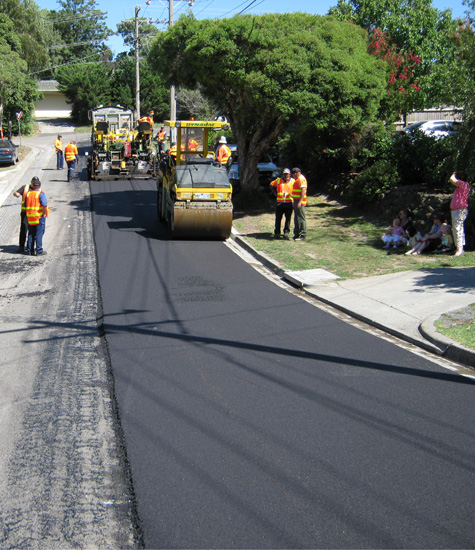
So, not surprisingly, WMA appeals to green-conscious councils and their communities, as well as state road authorities.
But as contractors and councils are finding out, WMA has practical and performance advantages way beyond its mere environmental attributes.
For a start, workability is improved, so compaction is easier, even with reclaimed asphalt pavement (RAP) in the mix.
And because WMA is produced at temperatures up to 40 degrees lower than HMA, the bitumen binders are less oxidised and therefore enhance surface durability when it comes to reduced fatigue cracking and asphalt surfacing.
WMA has been a late starter in Australia compared to America and Europe, but it began blipping louder on our radar in 2010 when positive results started emanating from validation trials on a 1.3km stretch of the Hume Highway which carries 24,000 vehicles a day near Melbourne’s outskirts.
Then, last year the 24-month validation project got a big tick from Austroads, and that added further momentum to the new technology’s trajectory. Essentially, Austroads said there was no discernible difference between WMA and HMA in terms of strength and function. Consequently most state road authorities have added WMA into their specifications.
Tipped to surge
Despite a warm mix presence in Australia for almost 10 years, its uptake has been at a rather static 2% of national production (compared with close to 20% in the USA).
But major asphalt supplier Boral says Australia’s uptake is now on the increase, following the recent nod from Austroads. They also report renewed interest by councils and state authorities.
So much so in fact, that the company’s National Technology Manager, Trevor Distin, has been invited to present a paper entitled ‘Warm mix – the asphalt of the future’ at the IPWEA’s National Conference in Darwin in August.
“My paper will explain how asphalt can be produced at a lower temperature without compromising its performance properties,” he says. “I also aim to show what the benefits are – for the environment, the community, the paving contractor and, most importantly, the asset owner.”
His paper will be supported by data on performance tests carried out on locally produced warm mixes using two different technologies – one involving an organic wax additive and another relating to the foamed bitumen process.
Bankstown success
Typical of many councils, Bankstown City Council has found Boral’s warm mix technology to be highly effective. They contracted Boral Asphalt to rehabilitate a major collector road (Sphinx Avenue) with Boral-branded WarmPave material.
“The job involved removing damaged pavement to a depth of 200mm and replacing it with about 2300 tonnes of WarmPave,” says Distin.
The team worked in mid-winter over four nights and, apart from all compaction and density requirements being met, the moisture content of the mix remained below specification limits even though work took place during a wet and humid July. In addition, a close monitoring of fuel usage during the project showed that a 30% less fuel had been used than might have been expected if laying hot mix asphalt.
“The job was also a good example of how multiple layers of warm mix can be laid and compacted in a much faster timeframe than traditional hot mix,” says Distin. “Another benefit was that 20% RAP was used in the base and intermediate courses, and 15% added to the wearing course to increase the stiffness and improve the rut resistance of the asphalt,” he adds.
Superway project
Another WarmPave contract that Boral clinched some time ago in South Australia was to supply and pave 3000 tonnes of material for construction of the DTEI’s South Way Superway project. This WMA work forms part of the $30-million contract awarded to Bardavcol to upgrade local roads provide alternative access during construction of the Superway.
The key to Boral’s production of warm mix has been to install a foaming unit on their batch plant. The unit injects a small amount of atomised water into the hot bitumen line prior to mixing with the heated aggregates. The foaming of the bitumen reduces the viscosity of the binder allowing the aggregates to be coated at a lower temperature. This means the mixing temperature of the aggregate can be reduced from around 160 to 135 degrees without affecting the workability of the asphalt during placement.
Moreover, since the bitumen binder is less oxidised, it imparts a longer life to the asphalt, and so to the pavement – which, needless to say, is pretty important to any asset manager with a long-term financial plan!
 |
Comment below to Continue the Conversation!
|